How This Started
Research conducted in the Dr. Alexandra Zevalkink Group at Michigan State University.
This project began during an honors materials science laboratory course, when a guest professor visited to discuss lab-grown materials and demonstrate examples with unusual physical behavior. One of the materials she brought was synthetic opal, which stood out to me because of its unique optical properties and the way subtle structural ordering can produce dramatic macroscopic effects.
After the class, I followed up with her to ask about the possibility of growing opal myself. While she encouraged that curiosity, she also explained that her research group primarily focuses on thermoelectric materials, particularly understanding how structure and processing influence transport properties. As part of that work, the lab also investigates crystal growth methods as a way to study and control material behavior.
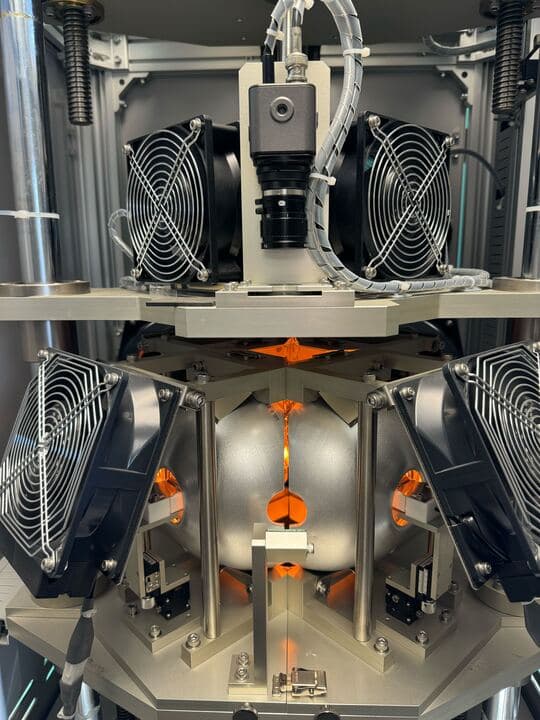
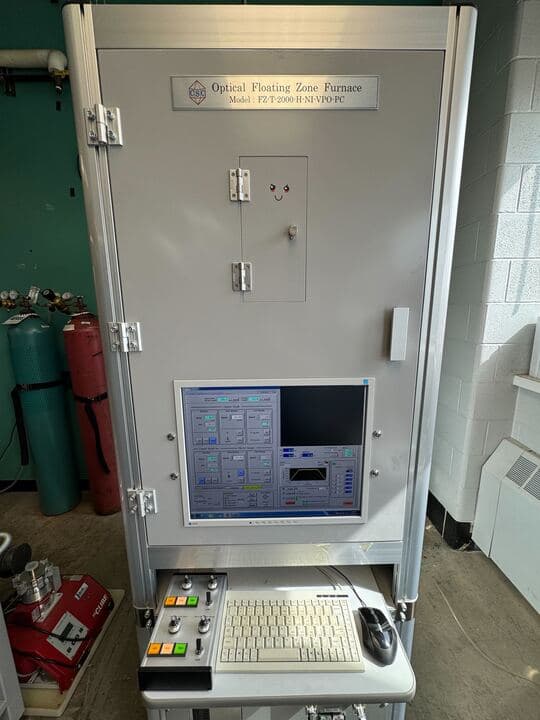
She proposed that I join the group to work on developing crystal growth techniques for thermoelectric materials using an Optical Floating Zone (OFZ) furnace, which would allow me to explore crystal growth in a more controlled and scalable research setting. I accepted the opportunity and began working in the lab through an independent study.
What started as a one-semester independent study grew into a multi-semester research effort, continuing beyond course credit and culminating in a successful application to the Michigan Space Grant Consortium Undergraduate Fellowship, which will fund the project from Summer 2026 through the end of the Fall 2026 semester.
Establishing a Growth Baseline
The OFZ furnace available in the lab is typically used for conventional floating-zone crystal growth, where a molten zone is suspended between feed and seed rods. In this project, however, the goal was to adapt the furnace for ampule-based optical traveling zone growth, where the material is sealed inside a quartz ampule and heated translationally.
This configuration introduces several challenges:
- The method is sparsely documented in literature, particularly for thermoelectric materials.
- Bi₂Se₃ contains volatile chalcogen elements, making vapor control critical.
- The furnace does not provide a direct temperature measurement at the growth zone.
- No established power-to-temperature calibration existed for this setup.
Before meaningful growth trials could begin, it was necessary to establish a reliable and repeatable baseline describing how the furnace interacted with Bi₂Se₃ under sealed ampule conditions.
What I Built and Tested
Rather than immediately pursuing single-crystal growth, I focused first on understanding and controlling the system.
High-purity bismuth and selenium were weighed in stoichiometric ratios, sealed under vacuum in cleaned quartz ampules, and melted to form homogeneous precursor material. Prior to growth experiments, samples were ground and analyzed using X-ray diffraction (XRD) to verify phase composition and confirm near-target stoichiometry.
Because the furnace lacks a calibrated temperature readout, optical power percentage was treated as the primary control variable. Furnace power was increased incrementally across repeated trials while visually monitoring the ampule to identify the onset of melting behavior. Through this process, a reproducible melting threshold of approximately 40% optical power was established for Bi₂Se₃ under the given furnace configuration.
This calibration-first approach ensured that subsequent growth attempts were grounded in repeatable conditions rather than exploratory trial-and-error.
Timeline
Spring 2025 — Independent Study (Baseline Calibration)
- Joined the Zevalkink Lab through an independent study
- Prepared Bi₂Se₃ precursor material in sealed quartz ampules
- Verified phase composition via XRD
- Performed incremental furnace power studies
- Identified ~40% optical power as the reproducible melting threshold
- Authored the OFZ Furnace Operator Manual to document procedures and improve lab reproducibility
Fall 2025 – Spring 2026 — Continued Lab Research
- Continued work beyond course credit
- Refined ampule preparation and furnace alignment
- Created improved ampule tip sharpness with the glass working lab
- Began documenting repeated attempts to create single-crystals
Fall 2026 — Funded Expansion (MSGC Fellowship)
- Awarded Michigan Space Grant Consortium Undergraduate Fellowship
- Continued experimental iteration and characterization
- Presentation of results at the 2026 MSGC Fall Conference
Current Experimental Work
With the melting baseline established, the current phase of the project focuses on iterative single-crystal growth attempts using the optical traveling zone method.
To improve zone stability and nucleation control, significant emphasis has been placed on ampule geometry, particularly producing sharply tapered ampules. Early attempts using in-house ampule fabrication methods resulted in geometric variability that made it difficult to draw consistent conclusions between runs. To address this, the project transitioned to ampules fabricated by the university’s glass working department, providing substantially improved consistency in tip sharpness, symmetry, and wall thickness.
At present, ampule geometry and furnace power are held fixed, and translation speed is treated as the primary experimental variable. Growth runs are conducted iteratively, with translation rate adjusted between experiments to observe its effect on melt-zone stability and grain evolution.
So far, all growth attempts have produced polycrystalline material rather than true single crystals. However, several runs have shown the formation of larger grains within the polycrystalline structure, indicating progress toward improved directional solidification and providing guidance for subsequent parameter adjustments.
This phase of the work is ongoing and represents the core experimental effort of the project.
Media & Documentation
Visual Overview
1 / 5
Supporting Documents
- Michigan Space Grant Consortium Fellowship Statement of Work (PDF)
- UURAF 2025 Research Poster (PDF)
- XRD Phase Analysis Summary (PDF)
Lessons & Next Steps
This project has emphasized the importance of process control and geometric consistency when working with underdocumented crystal growth configurations. In particular, it has shown that ampule fabrication quality can be as influential as furnace parameters in determining growth behavior.
Next steps include continued refinement of translation speed and thermal profiles to promote single-grain selection, followed by structural and physical characterization of successful growths. The methods developed here will be extended to other thermoelectric materials such as Bi₂Te₃, with the broader aim of improving understanding of crystal growth mechanisms relevant to energy conversion and space-based power systems.
This work has also played a significant role in shaping my academic trajectory, motivating the addition of a Materials Science and Engineering minor alongside Mechanical Engineering and reinforcing my intent to pursue graduate research in materials science.