What We Built
For this project, our team designed and manufactured a small desktop mechanism that converts rotational motion into linear motion. The final product functions as both a demonstration mechanism and a desk paperweight. Turning a small crank rotates a wheel that drives a linkage system, causing a slider to move back and forth along a track.
The goal was to create something that was both mechanically correct and visually interesting. When someone turns the crank, they can immediately see how the rotation of one component drives the motion of the entire mechanism. Projects like this are often used to demonstrate the fundamentals of mechanism design, since they make the relationship between motion and geometry easy to understand.
What made the project enjoyable was that it combined several aspects of mechanical engineering into a single build: designing the system, analyzing how it moves, manufacturing the parts, and finally assembling everything into a working mechanism.
Designing the Mechanism
The mechanism we built is a slider-crank system, a common mechanical linkage used to convert rotational motion into reciprocating linear motion. Similar mechanisms appear in engines, pumps, and compressors, where rotating components drive pistons or sliding parts.
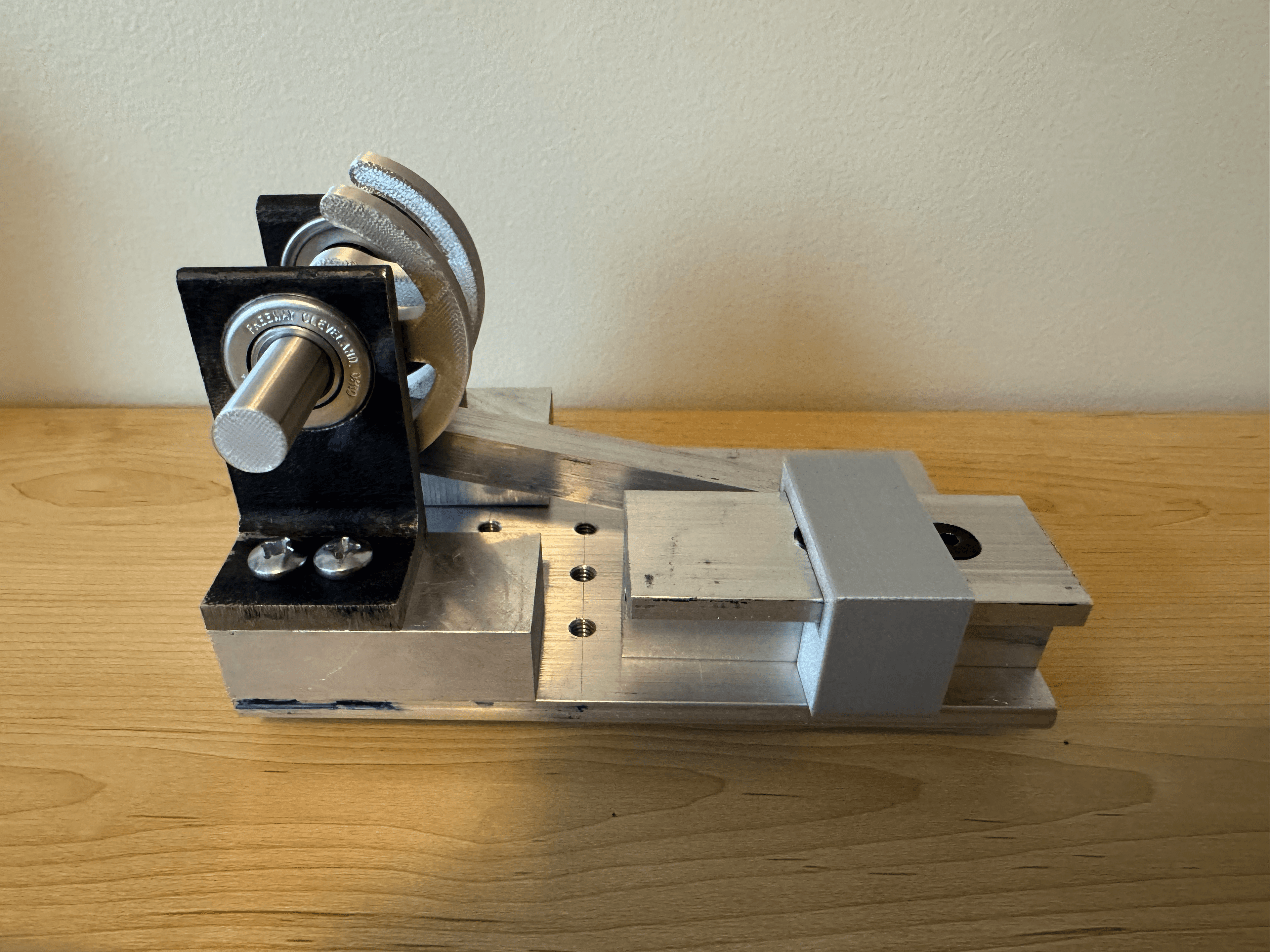
Our design process started with the four of us descussing posible designs. As we discussed our thoughts, each of us would jump in building off of one another. Adventually we came to our design that you can see in the picutres below (although slightly alterned).
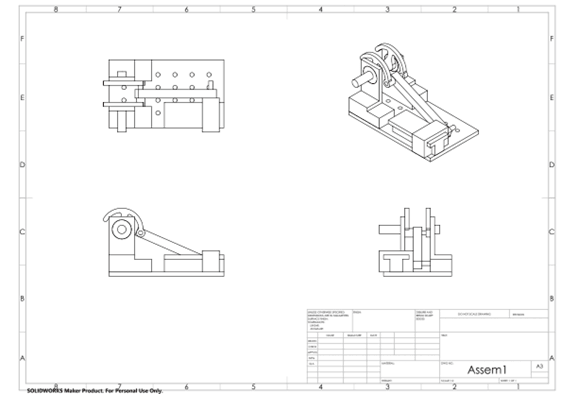
Then we moved to CAD, where we developed the geometry of the mechanism and ensured that all of the parts would fit within the required baseplate footprint. The design included several key components:
- A rotating crank that provides the input motion
- A connecting link that transfers motion through the system
- A sliding block that moves along a guided track
- A baseplate that holds the mechanism together
Each of these components had to work together smoothly so that a full rotation of the crank would produce a full reciprocating cycle of the slider.
To better understand how the geometry affected the motion, I wrote a MATLAB program to analyze the kinematics of the slider-crank mechanism. This allowed us to evaluate different arm lengths and quickly see how those changes affected the slider motion and transmission angle, helping the team choose dimensions that produced smooth and consistent movement.
Building the Parts
Once the design was finalized, we moved on to manufacturing the mechanism. This was done using a combination of traditional machining and 3D printing, depending on the complexity of each component.
Some parts were manufactured using standard machining processes in the manufacturing lab, including:
- drilling
- milling
- cutting stock material to size
Other parts, particularly those with more complicated geometry, were produced using 3D printing. This allowed us to create shapes that would have been difficult or time-consuming to machine manually. Especially the "Anchor" seen in the images below which was purely for its visual appeal.
After the individual components were completed, we assembled the mechanism and tested its motion. The final build was able to rotate smoothly through a full cycle, producing consistent sliding motion along the track.
Iteration and Problem Solving
Like most design projects, the first idea we had was not the one we ultimately built. Some of our early design concepts looked good in CAD but turned out to be difficult to manufacture with the tools available in the lab.
One example involved the geometry of the slider track. Our initial design used a more complex shape intended to hold the slider securely during inverted operation. After discussing the design with the lab staff, we realized that producing the required angled surfaces would require tooling that was not available in the shop.
To solve this, we redesigned the track using a simpler T-shaped geometry. This preserved the functional requirements of the mechanism while allowing the part to be manufactured using standard milling operations.
We also ran into trouble with many of the 3D prints. While 3D printing allows for almost limitless geometries, the dimensional tolerances are difficult to control compared to machining. This forced us to rely on trial and error to achieve a tight fit, resulting in many of the failed prints shown in the Physical Build Photos section.
My Contribution
My primary contributions were focused on the CAD design and manufacturing of the mechanism. I handled the CAD revisions as the design evolved, updating the models and drawings as we refined the geometry and simplified parts to better match what could realistically be manufactured in the lab.
I also wrote a MATLAB program used to analyze the kinematics of the slider-crank mechanism. The script allowed us to evaluate different crank and connecting-rod lengths by calculating slider displacement, transmission angle, and other motion characteristics across a full crank rotation. This made it much easier for the team to compare different design options and select arm dimensions that would produce smooth and consistent motion.
In the manufacturing phase, I helped machine most of the parts in the lab, performing operations such as drilling and milling, and then helped assemble the final mechanism once all of the components were completed.
Team
- Devin Grady
- Adam Sypitkowski
- Ryan James
- Christopher Kopiwoda (me)
Media & Documentation
Physical Demonstration Video
Physical Build Photos
1 / 5
CAD Motion Video
CAD Drawings & Models
1 / 11