How This Started
Many elderly individuals and people with conditions such as carpal tunnel syndrome or muscular dystrophy struggle with simple daily tasks like turning a key. Loss of grip strength and wrist mobility can make unlocking a door painful or impossible.
We wanted to design a purely mechanical assistive device that restores independence and dignity — without requiring electronics, batteries, or complex setup.
Event
MSU Designathon
System Type
Fully Mechanical
Focus
Accessibility & Inclusivity
What It Does
Yolkey is a handheld mechanical assistive device that reduces the force required to turn a key.
Instead of relying on grip strength alone, Yolkey:
- Converts a gentle push into amplified torque
- Uses gear reduction to multiply mechanical advantage (not shown in CAD)
- Secures a standard key in a swappable mount
- Enables unlocking doors with significantly reduced wrist strain
The result is a simple, durable, and battery-free accessibility tool.
Mechanical Design
Core Mechanism
The device integrates:
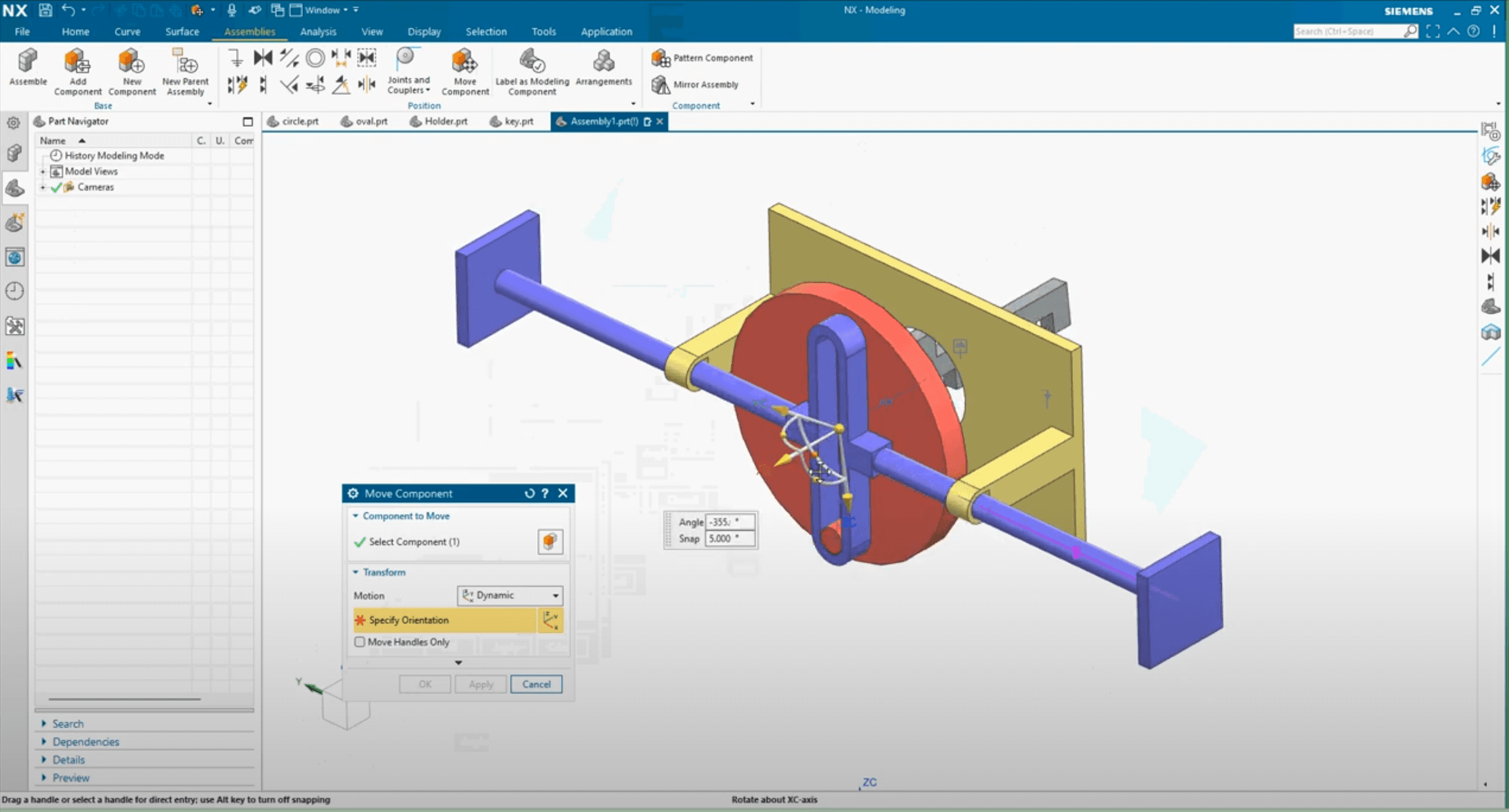
- A Scotch yoke mechanism
- A multi-stage gear reduction system
- A modular, swappable key-mounting interface
The Scotch yoke converts linear or limited rotational input into controlled rotational motion, while the gear train amplifies torque output to the key.
This combination allows force multiplication without increasing user effort.
My Contribution
I led the mechanical system design and CAD development:
- Designed all CAD models for the device
- Engineered the gear reduction system
- Developed the Scotch yoke integration
- Solved mechanism logistics to ensure smooth motion transfer
- Optimized torque amplification while maintaining compact form factor
- Iterated on tolerances and alignment to ensure the mechanism physically worked as intended
My primary focus was making the mechanism function reliably in the real world — not just conceptually.
Team
- Kiara Chance
- Eliana Kinzler
- Sadie Latragna
- Christopher Kopiwoda (me)
Challenges
- Designing a compact yet effective multi-stage gear system
- Maintaining mechanical advantage without excessive bulk
- Creating a secure but easily swappable key mount
- Balancing torque amplification with user comfort
- Ensuring alignment tolerances worked under real-world friction
What We’re Proud Of
- A working prototype (although extremely rough and gearless) that shows the scotch yoke mechanism
- A modular design adaptable to different key shapes
- A fully mechanical solution (no electronics, no batteries)
- Strong real-world applicability in accessibility design
What We Learned
- Mechanical advantage can be achieved creatively with minimal components
- User-centered design is critical in accessibility tools
- Small design decisions (gear size, handle angle, lever length) dramatically affect usability
- Physical prototyping requires iterative refinement and practical testing
What’s Next
- Refine the form factor for improved portability and aesthetics
- Conduct structured testing with elderly and mobility-limited users
- Explore injection-molded and 3D-printed production versions
- Improve ergonomics through handle redesign and grip optimization
Media & Documentation
Visual Overview
No images for the prototype are available but the video below demonstrates our design (without gears).